

Thank you for reading Theological Letters. To my subscribers, thank you for being here. To my paid subscribers, thank you for sustaining this work. A paid subscription costs about two coffees and unlocks my full archive, weekly letters, the 15-hour Orthodox Foundations lecture series, and monthly live Q&A sessions. If paid support isn’t possible, your likes and restacks truly help expand my reach. I appreciate you all.
23 Now it happened that He went through the grainfields on the Sabbath; and as they went His disciples began to pluck the heads of grain. 24 And the Pharisees said to Him, “Look, why do they do what is not lawful on the Sabbath?” 25 But He said to them, “Have you never read what David did when he was in need and hungry, he and those with him: 26 how he went into the house of God in the days of Abiathar the high priest, and ate the showbread, which is not lawful to eat except for the priests, and also gave some to those who were with him?” 27 And He said to them, “The Sabbath was made for man, and not man for the Sabbath. 28 Therefore the Son of Man is also Lord of the Sabbath.”
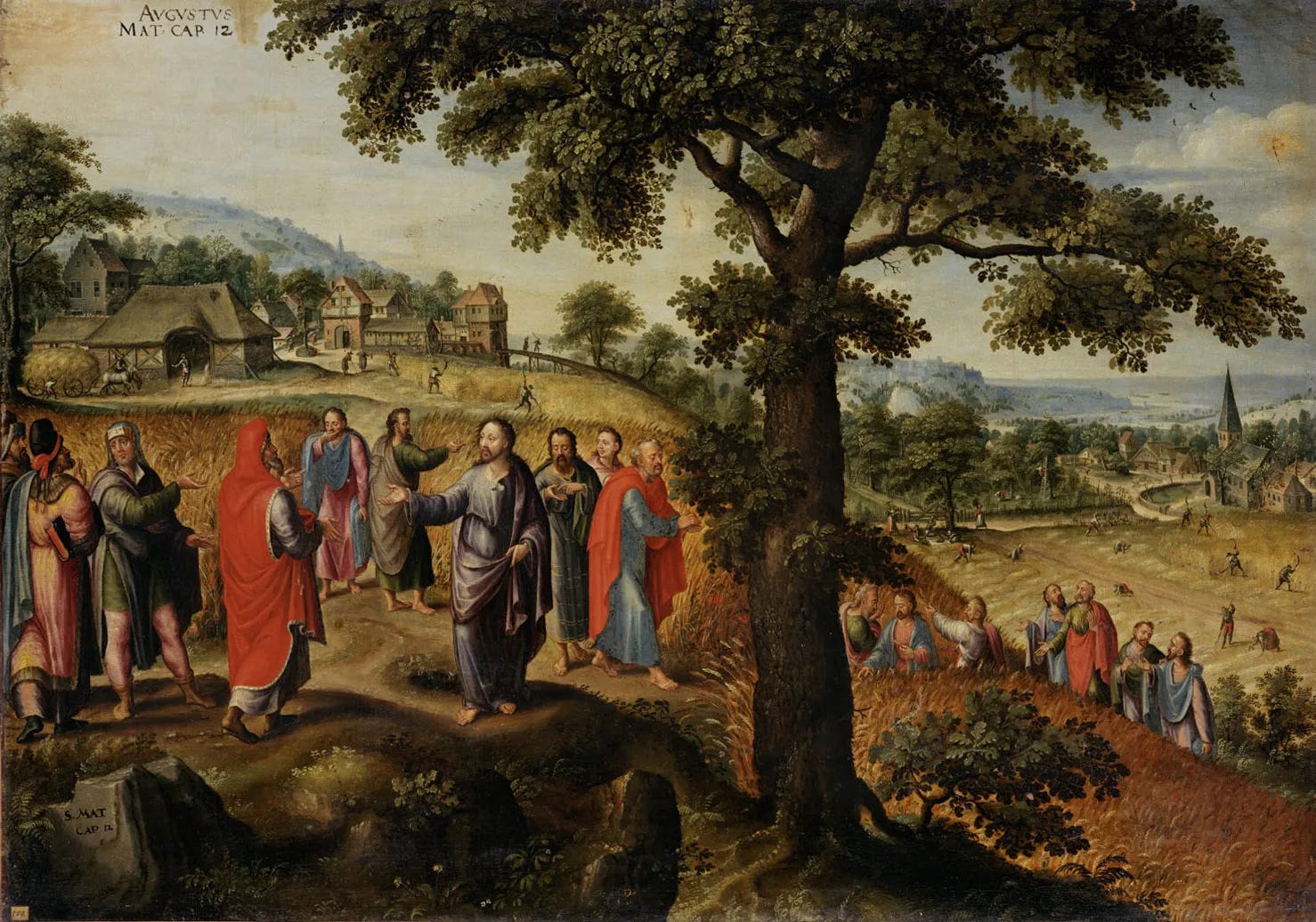
Mark 2:23-8
Notice that Mark does not say that Christ instructed his disciples to pluck the heads of grain. Rather, as he went through the grainfields on the Sabbath, they did so. And though the deed was unlawful, Christ did not prohibit them.
Unlike in the prior story, there is no mention of John’s disciples, only the Pharisees. In the previous event, the mixed company gave reason to think the questions about fasting were equally mixed in motive — some asking in good faith, others in bad. But here, the confrontation is evidently one of accusation and rebuke: Your disciples are doing something unlawful.
Notice two additional features of this accusation. Neither Christ nor his disciples have engaged the Pharisees. Rather, the Pharisees prove themselves to be busybodies, attending to the deeds of others, lying in wait to pass judgment on sinners. As Chrysostom puts it, “they are not vehemently provoked, but simply find fault” (Hom. 39).
The second feature is subtle. In commanding Christ to look (Ἴδε) — the word being in the imperative — they accuse him, too, charging him with negligence: This transgression is due to his inattention to his disciples. Thus, the command to look is not only a charge but corrective, leveled against the very Son of God.
Christ, well aware of their actions, defends their conduct. How? By appealing to an instance in which David, too, does something unlawful because “he had need” (χρείαν ἔσχεν). While fleeing from Saul, David and his men fled to the Tabernacle in Nob. While there, Ahimalech, Abiathar’s father, gave to him the showbread, which is unlawful for any but the priests to eat. Yet, David eats and gives the same to his men. The appeal to David is no doubt because the Pharisees revered him and dare not accuse him of sin. Yet, as Chrysostom argues, the thing done by David is a greater violation of the Law. He writes, “[Christ] brings another example greater than the Sabbath. For it is by no means the same, to break in upon a day, and to touch that holy table, which it was not lawful for any man to touch“ (Hom. 39, Matt.).
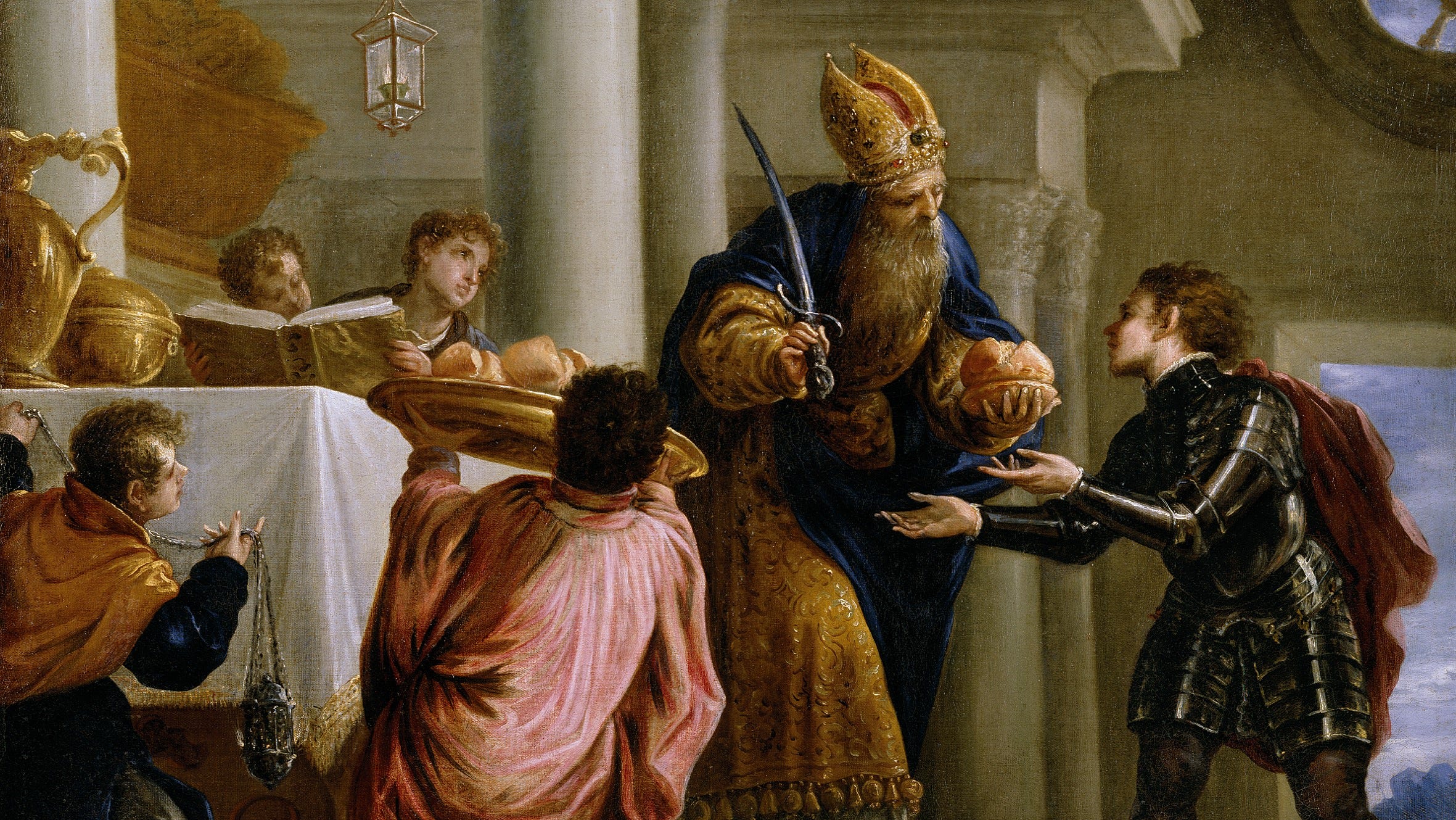
Now, of course, one might appeal to David’s rank as king or prophet. But the appeal is of no help. For, as Christ adds, the showbread was for priests only. Likely in anticipation of such an appeal, Christ adds two nuances.
The first is the mention of Abiathar. Abiathar was not the one who ministered to David, giving him the showbread; rather, this was done by Ahimalech, the father of Abiathar. So why mention Abiathar? Because Abiathar was the high priest, the archetype of the priests. By drawing attention to this archetype, Christ anticipates and quiets any appeal to David’s standing as king or prophet, reminding them — once again — the showbread was for priests only.
The second nuance to quell this reply is the mention of David’s men. These were neither kings nor prophets nor priests. Yet, David not only ate but gave to them to eat as well. To condemn their eating is to condemn the one who gave the showbread to them — David.

Both the appeal to need and the statement that the Sabbath was made for man show that the concern of the Law is the good of man — to orient him rightly toward God and to teach him with shadows about the substance to come, which is Christ. If at odds, the good of the man is to take priority over the Sabbath.
The point anticipates the next story in Mark’s Gospel (the healing of a man with a withered hand), where the Pharisaical concern for the Sabbath supersedes the good of man, condemning his healing as sin.
The same should be remembered in all ascetic practices: These are to aid one in putting to death the passions, turning the soul toward God, and cultivating humility and faith. They are not ends in themselves but means. The danger of the religious rigorist is the same as of the Pharisee: Losing sight of the purpose of ascetical practices, elevating the discipline over the one it exists to aid, and heaping on his shoulders burdens too heavy for him to bear.
We might ask, If need suffices to override the Law, then why not offer the same justification for other sins? Might the murderer make appeal to his anger or the adulterer his lust? Certainly not. So why does the need of hunger justify violating the Sabbath with eating?
Here, some help can be found in the traditional distinction between the natural law and the ceremonial law. Natural law acknowledges that there is an order to nature, reflective of providence and divine Wisdom, which weaves into the fabric of our world natural goods and evils. Evils, such as rape or murder, are so named because they violate the order of nature. These do not become evil when God prohibits them. Rather, God prohibits them because they are evil.1 But the same cannot be said for every command of God. There is nothing inherently evil about wearing a garment made from two different types of fabric, for example, but God prohibits this in the Old Testament (Lev 19:19) as a symbol to remind the Hebrews not to mingle with the surrounding Nations. Now, though there is no innate evil to wearing such a garment, there is an innate duty that man obey God, his Maker — just as a child has a natural duty to obey his parents. Hence, moral properties supervene on the act as a result of the command, not because of the innate good or evil of mixed garments. Such is the nature of the ceremonial law: These laws concerning certain foods or garments or washings were symbolic shadows, anticipating the substance of Christ. Their moral weight was found solely in the commands of God.
The distinction is important. Not even God can make rape or murder good, these being innately evil and contrary to the order of nature — order that is itself an expression of God’s own Goodness and Wisdom. But the same cannot be said for the ceremonial law. Because there is no innate good or evil to eating kosher or wearing unmixed garments or resting on a specific day of the week, these are all subject to change at the will of God. For his commands alone are what give them moral weight.
In this light, God can suspend the ceremonial law without permitting sin, since there is no innate good or evil to plucking grain for food on a Saturday. While he cannot suspend the order of nature that makes adultery wrong. The aim of all divine law, natural and ceremonial, is the good of man. Hence, we should not be surprised to find that when the ceremonial law conflicts with the need of a man, God makes a concession for his good.
Here, again, we see Christ invoke the title Son of Man, indicative of his divine authority (see comments on Mark 2:6-12).2 The title is supremely relevant here. For, as discussed, the moral teeth of the ceremonial law is the command of God. Hence, it is also God’s prerogative to suspend such laws. Here, Christ does precisely that, and the suspension is not capricious but in keeping with the spirit of the Law, which is the good of man. Hence, he who is Lord of the Sabbath permits his disciples to take and eat because he recognizes their need.
Both Cyril and Chrysostom identify another dimension to Christ’s concession. They see in this Christ’s patient instruction, slowly orienting his disciples (and mankind) to the ways of the new covenant.
As noted previously, Mark is very intentional about the order of stories, each one offering interpretive aid to the next. In the story prior to this encounter, Christ spoke about the need to place new wine in new wineskins. The metaphor was to illustrate that his fresh teachings require pliable vessels to receive them, since the rigidity of the old system cannot accept the new — a fact proved by the response of the Pharisees. But in the case of the disciples, we see Christ gradually orient them to the changes that accompany his coming.
Chrysostom sees in this minor concession — plucking grain — a slow initiation into these new realities. Though Christ wills that his disciples move past the Law, he does not will for them to simply break it “without a cause, but giving reasonable excuses: that He might at once bring the law to an end, and not startle them” (Hom. 39). As part of the education of the disciples, Christ weens them off of the Law, transitioning from the old to the new gradually. These new wineskins are being stretched, educated in the new way, but only incrementally, lest they burst. Much like the way Christ does not heap upon them every burden at once, holding back knowledge of his impending crucifixion, for example (see Mark 2:6-12), so here, he only gradually introduces them to the ways of the new covenant.
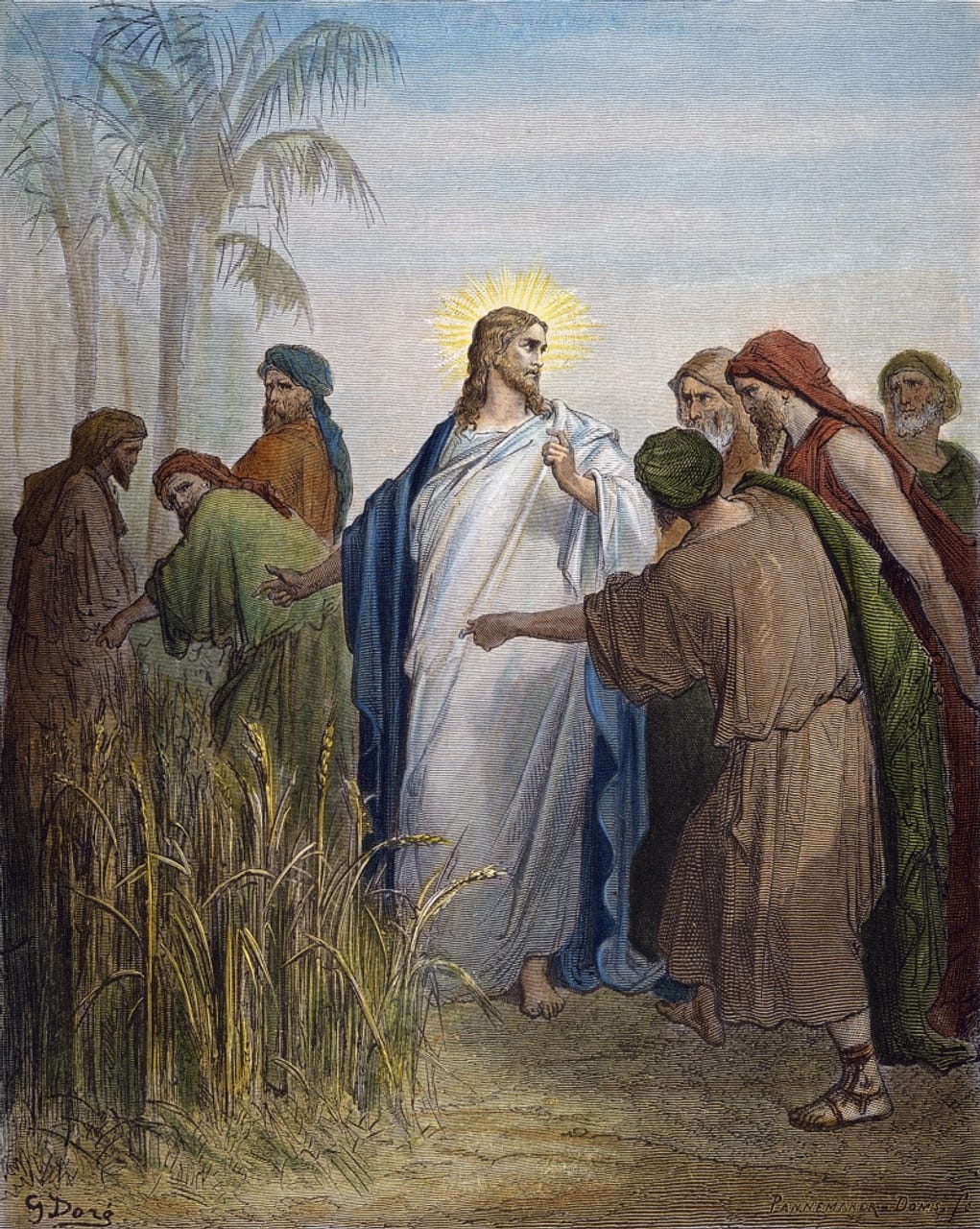
Cyril appeals to the Old Testament prophecies that God will bring a new covenant. He then argues that if a new covenant arises, then one must abandon the laws of the old. And this transition from old to new begins with Christ’s disciples (Hom. 22).
Such language might lead one to think the Sabbath is little more than an empty husk to be discarded. Yet, Chrysostom argues that the lesson Christ here teaches — and will teach again when healing the man with the withered hand — fulfills the purpose of the Sabbath. So, what was that purpose? In answer, Chrysostom points out a great many goods that the Sabbath taught men: “it made them gentle towards those of their household, and humane; it taught them God’s providence and the creation, as Ezekiel says; it trained them by degrees to abstain from wickedness, and disposed them to regard the things of the Spirit” (Hom. 39, Matt.). But it taught this by teaching them to refrain from all work. Having learned to bind their hands from all things on the Sabbath, they can now move into the fulfillment of this: Binding their hands from evil only — not from good. And this, Chrysostom argues, was already hinted at darkly through the prophets by adding to the command an exception, “You must do no work, except what shall be done for your life” (Ex 12:16). So, Chrysostom goes on, “even by the very shadow He was secretly opening unto them the truth” (ibid).
All of this raises how the Sabbath would come to be received and practiced within the Eastern fathers. To no surprise, they see it as a shadow of the substance that arrived in Christ (Col 2:16-7). So, what is the substance that has now come? The answer carries us into the doctrine of the Eighth Day of Creation and the distinction between the Sabbath and the Lord’s Day.
We see the distinction quite plainly in Ignatius of Antioch. For example, “If, therefore, they who were under the older dispensation came into a new hope, no longer keeping the Sabbath, but living in observation of the Lord’s day, on which day also our life rose through him and through his death, ...” (Ep. Magnesia, 9). The Church assembled on the Lord’s Day, which was linked with the Resurrection of Christ, as opposed to the Sabbath.3 The reason why the Resurrection was linked with Sunday was both historical and theological. Historically, Christ was crucified on Friday, descended into Hades on Saturday, and rose on Sunday. Theologically, this carries us into the Eighth Day of Creation.
Notice within the Genesis creation story, each day has a beginning and end — all except the Seventh. Notice also that the Eastern fathers do not understand the making of man to be complete until the Resurrection of Christ. The point goes to a distinction, common amongst these fathers, between the image and likeness of God. The Eastern fathers observe that God sets out to make man in his own image and according to his likeness but then creates man in his own image — likeness is not repeated. They take the omission to be significant. The image of God refers to man’s higher nature — reason, will, and his capacity to commune with God. The likeness, by contrast, is man’s active imitation of God by which he comes to partake of the divine nature and become something more than a mere animal. But in the Fall, man turns away from God and fails to attain this likeness. In a word, his making is incomplete. This, they believe, is the very purpose of the Incarnation: To heal human nature and complete the making of man. The first time we see what man was created to be is in the Resurrected Christ.

This understanding is the basis for the Eight Day of Creation. Genesis places redemption history within the Seventh Day of Creation. When talking about God’s words to Adam that in the day you eat of it you will die, Ireanaeus points out that, for God, a day is as a thousand years and thousand years as a day. He takes Adam’s longevity to indicate that such talk concerns divine days, not solar days, and he goes on to say that Christ died in the same day as Adam. In other words, the Seventh Day of Creation spans from divine rest following the making of man to the completion of the making of man by Christ. With the Resurrection of Christ dawns the Eighth Day, the New Creation as new life begins to spread to those who join themselves to Christ. To quote Athanasius, “The Sabbath was the end of the first creation, the Lord’s day was the beginning of the second, in which he renewed and restored the old” (On Sabbath and Circumcision, 3; see also Epistle of Barnabas, 15).
Returning, then, to the assembly of the Church on the Lord’s Day, what is commemorated is the dawn of the New Creation. What was formerly celebrated on Saturday under the shadows of the Law was the divine rest after making the world. But with the dawn of the New Creation comes the commemoration of the Eighth, ushered in on Sunday by the Resurrection of the Second Adam.

Such a position is the dominant view within the Christian position. The Eastern Church fathers, being realists, believe in an objective order of nature that carries with it natural goods and evils. And such was the dominant position amongst the medieval scholastics in the Latin West, a position that continued to echo amongst protestant scholastics after the Reformation (see the work of Stephen Grabill on this). The sole exception are the divine command theorists, who reject the idea of natural goods and invert the relationship, suggesting that moral properties only intervene on nature as a result of divine commands, and therefore, God could command rape, murder, and other such horrors, making them good. Such a view was largely associated with nominalism, which first arose with the late-medieval scholastics.
Chrysostom also sees in this title a reminder of the Incarnation. Christ has joined in his person divinity with our humanity. And Christ reminds us of this not only in the title, Son of Man, but also in the iteration in this passage that the Sabbath was made for man, not man for the Sabbath.
See, e.g., Justin Martyr, First Apology, 47. Other early sources that testify to the point include Didache, Epistle of Barnabas, and Clement of Alexandria.