

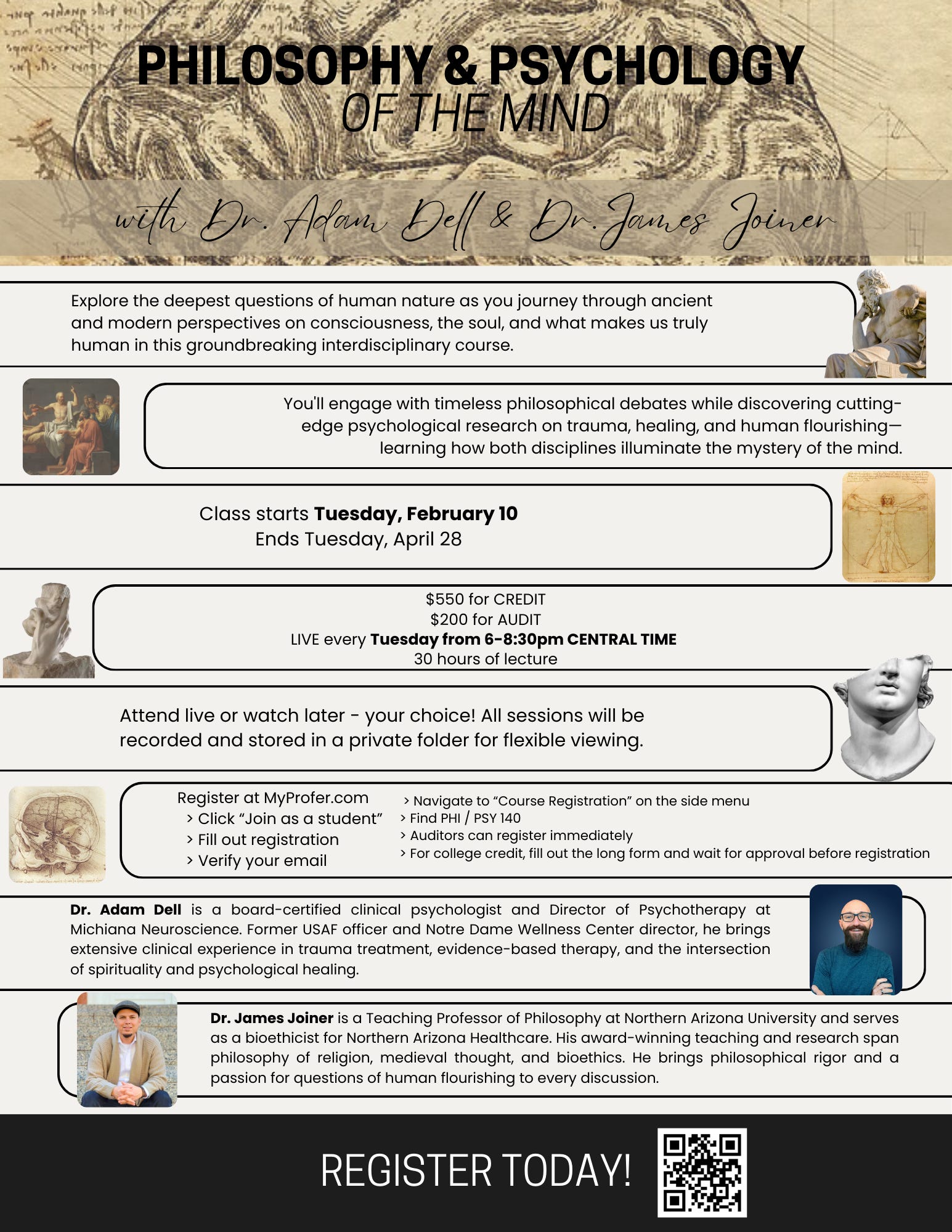
Greetings subscribers! I want to take this opportunity to commend to you an upcoming class, team-taught by Dr. Adam Dell, a board-certified clinical psychologist with vast expertise in trauma and emotional wellbeing, and Dr. James Joiner, a brilliant philosopher and one of the most gifted teachers I have ever had the privilege to observe. This rare opportunity features interdisciplinary dialogue between psychology and philosophy at the highest level — itself a rarity — while delving into profound questions about the human person, such as questions about free will, the soul, what it means to be human, and how such questions inform our understanding of human flourishing and equip us to face and overcome life’s struggles. Whether taking the course for credit (the class is accredited) or for audit, this class is an unparalleled chance to learn at the feet of these two exceptional scholars. I cannot recommend it highly enough to anyone and everyone. Here’s a trailer as a taste of what to expect. Or scroll to the bottom for more details.
Now I’ll hand the keyboard over to Dr. Dell. Enjoy!
Dr. Dell is a board-certified clinical psychologist with over twenty years of clinical experience, a former United States Air Force medic and active-duty psychologist, former Director of Emotional Wellbeing at the University of Notre Dame, and a current instructor in the Trauma Certification Program at Wheaton College. Across military, medical, academic, and clinical contexts, his work has consistently centered on the assessment and treatment of trauma and its effects on the human person.

This essay accompanies a course I will be teaching with Dr. James Joiner on myprofer.com. My portion of the class examines the relationship between trauma and the nature of the human person. Our first class meets on Tuesday, February 10, from 6:00–8:30 PM (Central Time) and will convene live via Zoom under the course designation PHI/PSY 140. The course brings together clinicians, students, and scholars to examine both Philosophical Anthropology and Psychological Traumatology.
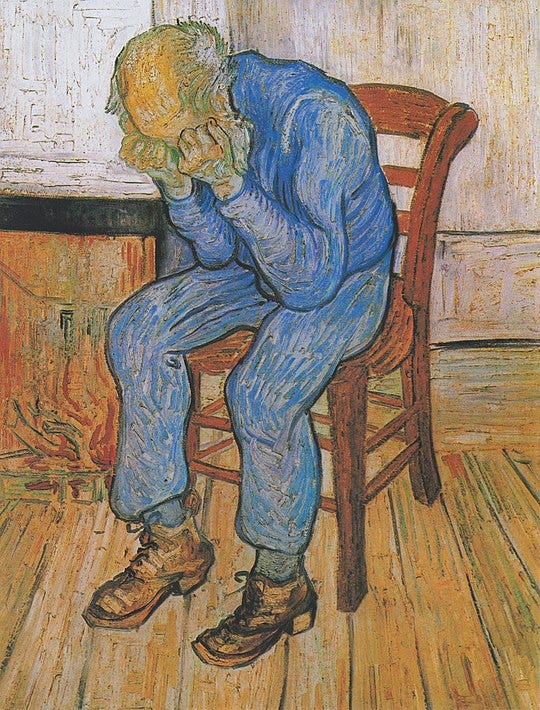
The study of psychological trauma offers a uniquely clarifying lens through which to examine fundamental questions of anthropology: What is a human being? How do persons relate to threat, meaning, memory, embodiment, and relationship across time? Trauma is not merely an abnormal psychological event affecting a subset of individuals; rather, it exposes core features of human functioning—our vulnerability, relationality, neurobiological plasticity, and meaning-making capacities. Examining trauma therefore reveals not only how humans suffer, but how they adapt, resist, fragment, and ultimately strive toward integration and healing.

This essay outlines the ways in which trauma, as formally defined within the DSM-5-TR, illuminates essential realities about the human condition across the lifespan. Drawing on epidemiological data from the International Society for Traumatic Stress Studies (ISTSS) and the American Psychological Association (APA), and integrating representative theories of personality, I argue that trauma research functions as a kind of anthropological stress test, exposing what is most fundamental about human beings under conditions of threat.

Defining Trauma: DSM-5-TR and the Human Encounter with Threat
The Diagnostic and Statistical Manual of Mental Disorders, Fifth Edition, Text Revision (DSM-5-TR) defines trauma exposure as direct or indirect exposure to actual or threatened death, serious injury, or sexual violence. This includes direct experience, witnessing, learning of trauma to close others, or repeated exposure to aversive details of traumatic events. Disorders such as Posttraumatic Stress Disorder (PTSD) are characterized by symptom clusters involving intrusion, avoidance, negative alterations in cognition and mood, and alterations in arousal and reactivity.
Anthropologically, this definition highlights several core realities about human beings. First, humans are meaning-oriented organisms: traumatic stress is not defined solely by the objective event, but by the subjective appraisal of threat, helplessness, and violation. Second, memory is not a neutral recording device. Traumatic memory is often fragmented, state-dependent, and somatically encoded, revealing that human cognition is inseparable from affective and bodily processes. Third, trauma underscores the fundamentally relational nature of the human person—both in how trauma is often inflicted through relational betrayal, and in how recovery is powerfully shaped by relational safety.
Epidemiology of Trauma Across the Lifespan
Epidemiological data consistently demonstrate that trauma exposure is common rather than exceptional. The ISTSS and APA report that a majority of adults worldwide will experience at least several potentially traumatic events in their lifetime. Prevalence rates vary by region, gender, socioeconomic status, and exposure to conflict or disaster, but trauma is a ubiquitous human experience.
Childhood trauma is particularly significant because it occurs during periods of rapid neurodevelopment, identity formation, and attachment consolidation. Adverse childhood experiences (ACEs)—including abuse, neglect, household dysfunction, and community violence—are associated with increased risk for mood disorders, substance use disorders, cardiovascular disease, autoimmune conditions, and reduced life expectancy. These findings reveal the profound developmental plasticity of human beings, as well as the enduring imprint of early relational environments.
In adulthood, trauma exposure continues through interpersonal violence, accidents, medical trauma, military combat, and collective traumas such as pandemics and natural disasters. Later-life trauma, including illness, loss, and cognitive decline, further demonstrates that vulnerability to threat persists across the lifespan, while also highlighting the role of accumulated resilience, meaning-making, and social support.

Trauma and the Lifespan: Continuity and Change
From an anthropological perspective, trauma reveals that the human person is both historically continuous and dynamically adaptive. Early trauma can shape stress-response systems, attachment patterns, and core beliefs about safety and worth. Yet longitudinal research also demonstrates variability in outcomes, with many individuals showing resilience or posttraumatic growth.
This dialectic—between vulnerability and adaptability—suggests that human beings are not fixed entities but developmental processes. Trauma impacts neural circuitry, particularly in systems governing threat detection (amygdala), contextual memory (hippocampus), and executive regulation (prefrontal cortex). At the same time, neuroplasticity allows for reorganization in response to corrective experiences, therapy, and relational repair.
Personality Theories and Trauma: Windows into the Human Condition
Psychodynamic Perspectives
Psychodynamic theories view trauma as overwhelming affect that cannot be adequately integrated into existing psychic structures. From this perspective, trauma reveals the defensive architecture of the human mind—repression, dissociation, projection—as adaptive responses to intolerable experience. Object relations and attachment-based models emphasize how early trauma disrupts internalized relational templates, shaping expectations of self and other across the lifespan.
Humanistic and Existential Perspectives
Humanistic theories frame trauma as a violation of core needs for safety, autonomy, and meaning. Carl Rogers emphasized conditions of worth and the self-concept, while existential thinkers such as Viktor Frankl focused on meaning in the face of suffering. Trauma exposes the human struggle to maintain coherence, dignity, and purpose under extreme conditions.
Cognitive Theories
Cognitive models conceptualize trauma in terms of disrupted belief systems about safety, trust, power, esteem, and intimacy. Traumatic experiences shatter assumptive worlds, leading to maladaptive appraisals and persistent threat perception.
Behavioral Perspectives
Behavioral theories focus on conditioning processes, avoidance, and reinforcement. Trauma reveals how fear responses become generalized and how avoidance, while initially protective, restricts functioning over time.

Neurobiological Perspectives
Neurobiological models frame trauma as dysregulation of stress-response systems, including the hypothalamic-pituitary-adrenal (HPA) axis and autonomic nervous system. Trauma research demonstrates that psychological experiences can produce measurable changes in brain structure, immune functioning, and epigenetic expression.
Trait and Personality Structure Theories
Trait theories examine how stable personality characteristics—such as neuroticism, conscientiousness, and openness—interact with trauma exposure to influence outcomes. Trauma highlights both stability and malleability in personality functioning, showing that traits can moderate risk while also shifting in response to extreme stress.
Trauma, Anthropology, and Moral Meaning
Beyond symptomatology, trauma raises profound moral and anthropological questions. It confronts clinicians and communities with realities of injustice, violence, and human-inflicted harm. Trauma exposes the ethical dimension of human life: the capacity to wound and to heal, to betray and to protect.
In a 2025 book I co-authored titled Freedom to Heal, I argue that recovery from trauma is not merely symptom amelioration but the restoration of agency, relational capacity, and moral meaning. Healing involves reclaiming authorship over one’s story and re-entering the world of shared human vulnerability with wisdom rather than fear.

Conclusion
The examination of trauma reveals essential truths about the human person. Humans are meaning-making, relational, embodied, and developmentally dynamic beings whose deepest vulnerabilities coexist with remarkable adaptive capacities. Trauma research functions as applied anthropology, illuminating how persons respond when their most basic assumptions about safety, trust, and identity are threatened.
Across theories of personality and stages of the lifespan, trauma underscores a central paradox of human existence: we are fragile, yet resilient; shaped by our histories, yet capable of transformation. To study trauma, therefore, is not only to study pathology, but to encounter the contours of what it means to be human.
References
American Psychiatric Association. (2022). DSM-5-TR: Diagnostic and statistical manual of mental disorders (5th ed., text rev.). American Psychiatric Publishing.
American Psychological Association. (2017). Clinical practice guideline for the treatment of posttraumatic stress disorder (PTSD). American Psychological Association.
American Psychological Association. (2023). Trauma. In APA Dictionary of Psychology. American Psychological Association.
Brewin, C. R., Andrews, B., & Valentine, J. D. (2000). Meta-analysis of risk factors for posttraumatic stress disorder in trauma-exposed adults. Journal of Consulting and Clinical Psychology, 68(5), 748–766.
Kolb, B., & Gibb, R. (2011). Brain plasticity and behaviour in the developing brain. Journal of the Canadian Academy of Child and Adolescent Psychiatry, 20(4), 265–276.
McEwen, B. S. (2007). Physiology and neurobiology of stress and adaptation: Central role of the brain. Physiological Reviews, 87(3), 873–904.
Miller, W. R., & Rollnick, S. (2013). Motivational interviewing: Helping people change (3rd ed.). Guilford Press.
Rogers, C. R. (1961). On becoming a person: A therapist’s view of psychotherapy. Houghton Mifflin.
Schultz, T., Estabrook, H., & Dell, A. D. (2025). Freedom to Heal: A Christian clinician’s guide to treating child sexual abuse. IVP Academic.
Shalev, A. Y., Ankri, Y., Israeli-Shalev, Y., Peleg, T., Adessky, R., & Freedman, S. (2012).
Prevention of posttraumatic stress disorder by early treatment: Results from the Jerusalem
Trauma Outreach and Prevention study. Archives of General Psychiatry, 69(2), 166–176.
Southwick, S. M., Bonanno, G. A., Masten, A. S., Panter-Brick, C., & Yehuda, R. (2014). Resilience definitions, theory, and challenges: Interdisciplinary perspectives. European Journal of Psychotraumatology, 5(1).
van der Kolk, B. A. (2014). The body keeps the score: Brain, mind, and body in the healing of trauma. Viking.
Widiger, T. A., & Costa, P. T. (2013). Personality disorders and the five-factor model of personality (3rd ed.). American Psychological Association.
Yehuda, R., & McFarlane, A. C. (1995). Conflict between current knowledge about posttraumatic stress disorder and its original conceptual basis. American Journal of Psychiatry, 152(12), 1705–1713.