

Greetings subscribers! As many of you know, I spent Holy Week and Bright Week at Vatopedi Monastery on Mount Athos. During that visit, I found myself in a number of conversations with monks, discussing traditions about characters from the gospels — some named, others unnamed. These conversations gave rise to the concept for a book, which Vatopedi subsequently blessed and offered to publish.
The book is tentatively titled The Supporting Cast of the Gospels: The Names and Fates of Those Who Met Jesus.
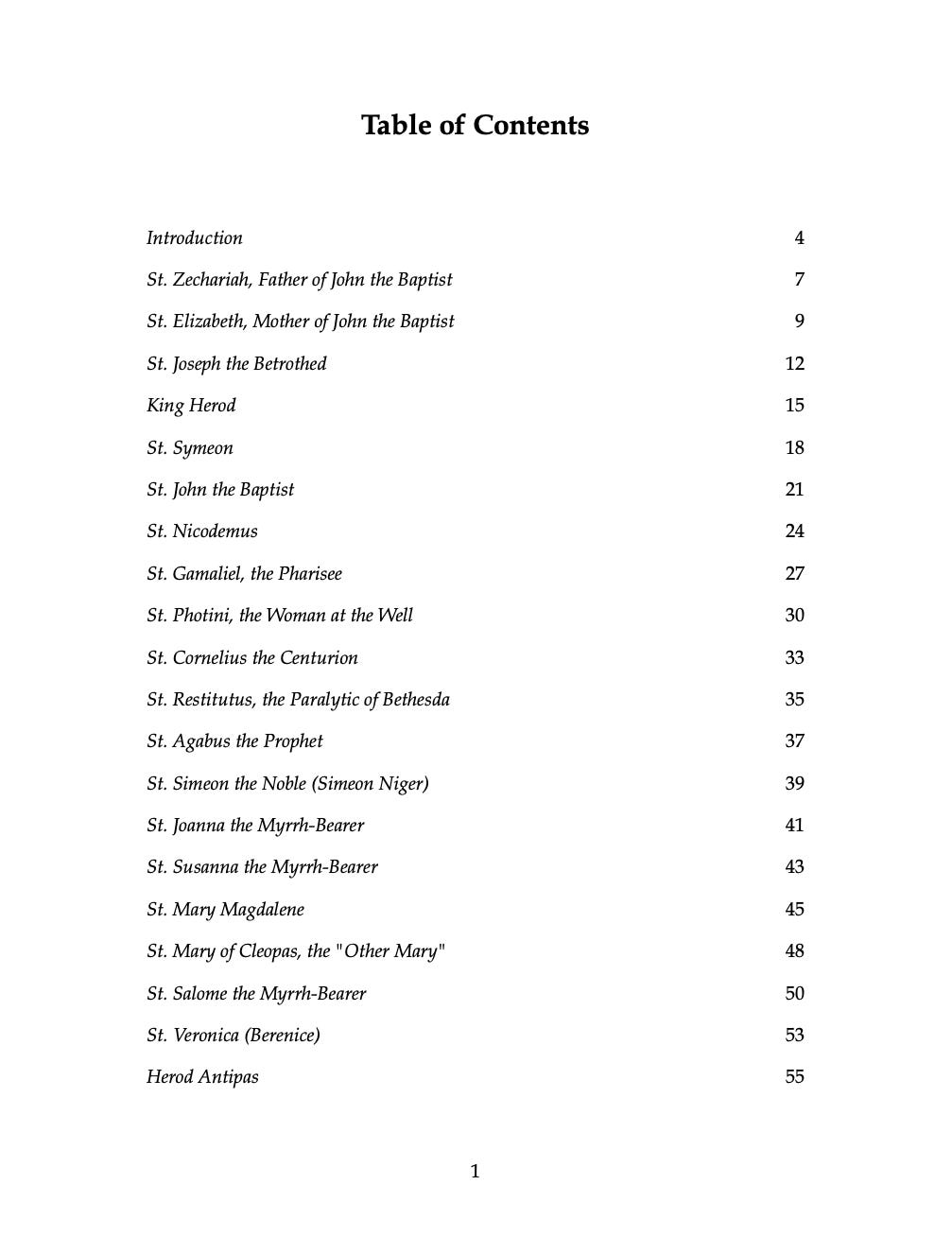
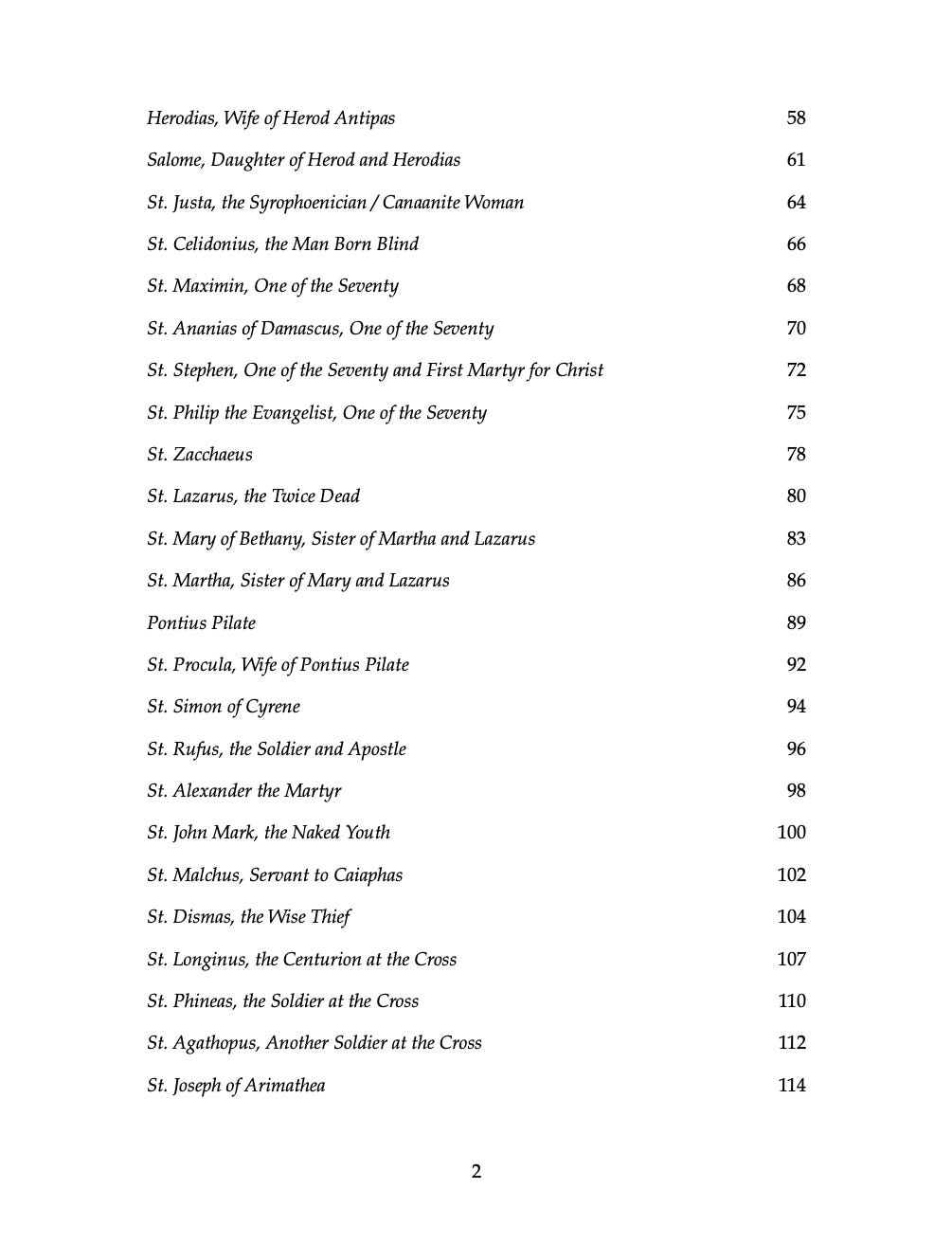
The volume catalogues all ancillary characters — excluding Christ, Mary, and the Twelve — into a comprehensive list of both named and unnamed characters, whom I’ve dubbed the “supporting cast of the Gospels.” I offer a brief account of the traditions, both biblical and extra-biblical, about each figure. Following each account, I discuss the source material, its dating, its status in the Orthodox Church, and its reliability.
The volume is concise and accessible, aimed at a broad audience — truly, anyone who is curious about the traditions handed down about these characters.
Over the following weeks and months, I plan to release three accounts per week — one free, two paywalled — until the entire volume is available here on Substack. More likely than not the volume will undergo revision before making its way from Substack to print, as I’m waiting on feedback from the monks of Mount Athos. However, I expect the essence to remain the same.
Below, you’ll find a capture of the Table of Contents and my Introduction. Next week, I’ll release the chapters on the first three figures: St. Zechariah, Father of John the Baptist; St. Elizabeth, Mother of John the Baptist; and St. Joseph the Betrothed.
Be watching for more in the coming weeks. If you wish to unlock the whole of these stories, become a paid subscriber. Enjoy!
A quick reminder before jumping in: The East-West Series—a comprehensive 26-lecture exploration of the theological differences between Eastern and Western Christianity—is now out of pre-production and well into production, with block 1 filmed and the remaining two blocks scheduled to be complete by October 9. Post-production is underway in tandem with filming, and the first three episodes will drop at the end of October, followed by weekly releases.
We are currently crowdfunding the series at the lowest price it will ever be available—an offer that expires on October 15. Visit theeastwestseries.com to support or purchase the series and explore various tiers and benefits, including one-on-one meetings, Q&A access, and class participation.

Introduction
I have heard time without number a curious Protestant wonder, What ever happened to the woman at the well? To those familiar with Church Tradition, the immediate reply is simply, You mean Photini?
It often comes as a surprise to modern Christians that the early Church did not simply drop the curtain when a Gospel character walked off stage, relegating the rest of their story to the unwritten events of history. The fact is that the ancient Church passed down a rich, vibrant tapestry of stories about the characters surrounding Jesus—not just Mary, his mother, or the Twelve Apostles, but figures like Zacchaeus, Symeon, and even the unnamed, like the young man who fled naked into the night when Jesus was arrested in Gethsemane.
When reading a distant history, it is easy enough to forget a simple fact. These characters were not flat, two-dimensional literary devices created to drive a plot point; they were real, breathing human beings who entered into a living Church community. The people in these stories became Christians—sometimes clergy. They joined local assemblies, broke bread together, buried one another, and shared stories, passing their memories down to the communities that would eventually record, preserve, and defend the Faith.
Saint John writes at the close of his Gospel: “And there are also many other things which Jesus did, the which, if they should be written every one, I suppose that even the world itself could not contain the books that should be written” (John 21:25). How much more would the world fail to contain the books if we added to this everything concerning the lives, labors, and deaths of all the people surrounding him?
This brings us to the nature of Tradition in the Eastern Orthodox Church, the Church whose traditions are the focus of this volume. How are we to evaluate these stories that have been passed down over centuries?
The first thing we must remember is precisely the point made above. In Christian antiquity, tradition is not a game of telephone; it is the organic, lived memory of a family. Yet, not all traditions—not all stories—carry the same weight. Some accounts are held with profound reverence, being traced to the earliest centuries of oral memory, held firmly as an accurate history. They are preserved in ancient hymnody, depicted in early iconography, and anchored in the veneration of holy places and relics left behind by holy people and events.
Saint Basil the Great, in his classic treatise On the Holy Spirit, draws a distinction between dogma and kerygma. These words today are often translated “teaching” and “preaching,” but Basil’s definitions are reflective of the more ancient way of thinking about such matters. Dogma is the lived faith and practices of the Christian Church, handed down in her mysteries—in sacrament, liturgy, and prayer. Kerygma is the public articulation and defense of this lived faith, occasioned more often than not by the rise of heresy. The distinction is telling, because it treats the dogma of the Church, not first as something written in academic volumes, but rather as something preserved in a lived faith, in a community, in the Church herself. These foundational hagiographical memories are tied directly to the lived experience of the Church—memorialized in her liturgical calendars, celebrated year after year in memory of God’s deeds in and through his people across centuries.
Now, this is not to say that every tradition is held with such fervor. Some stories fall into the realm of later folklore or pious romance—tales with very little historical evidence to support them. This is not to say such stories are obviously false or without value, but it is to say they are difficult to verify and, for this reason, are held quite loosely by the Church—if held at all.
And then there are any number of degrees in between: historical traditions cited by early Church fathers and preserved in local Martyrologies that are deeply respected, yet fall outside the strict boundaries of core dogma. There are stories that show evidence of being true but have been confused in the passing down, ascribing the deeds of this Saint to another of the same name.
This array of traditions and reliability brings us to the book you now hold in your hands. This work is a curated collection of stories about the “supporting cast” of the Gospels. You will not find here extended biographies of the Virgin Mary, comprehensive treatments of the Twelve Apostles, or apocryphal tales of Jesus’ childhood or unwritten miracles of the kind John acknowledges exist. Instead, this volume isolates the secondary characters who encounter Christ across the four Gospels, gathering their names, extra-biblical stories, and ultimate fates.
Following each profile, I have provided a section on “Source Material.” This minor postscript is meant to serve as an objective report, explaining where each story originates, how far back the written records date, how strongly the tradition is held by the Orthodox Church, and how modern scholars view its plausibility.
Nothing in this book is written to dictate what you must believe. You are free to trust the historic memory of the Church fully, to view these accounts through a lens of cautious historical skepticism, or to land anywhere in between. My goal is simply to act as a reporter and collector—presenting the full picture of this supporting cast as preserved by Christian tradition.
A note on the organization of this volume: the order of these profiles is an intentional attempt at chronology. Well known is that the four Gospels do not follow a uniform chronology, and harmonizing them has challenged scholars since the days of Tatian. Taking into account the historical efforts of the Church fathers to harmonize the Gospel accounts, I have ordered these figures to generally reflect the sequence of their appearance in the earthly life and ministry of Christ.
As for audience, I have written this book for the broadest possible audience. While built on scholarly research and historical scholarship, it is crafted to be supremely accessible, clear, and engaging for anyone curious about the Bible—whether you are a seasoned scholar or a layperson sitting in a coffee shop, curious about the rest of the story, this volume is for you.
My hope is that as you read about these men and women who met the Word of God made flesh along the dusty roads of Judea and Galilee, these tales will not only enrich your reading of the Gospels but also edify your soul.
Look forward to the book. thank you for your work
Consider this my pre-order.