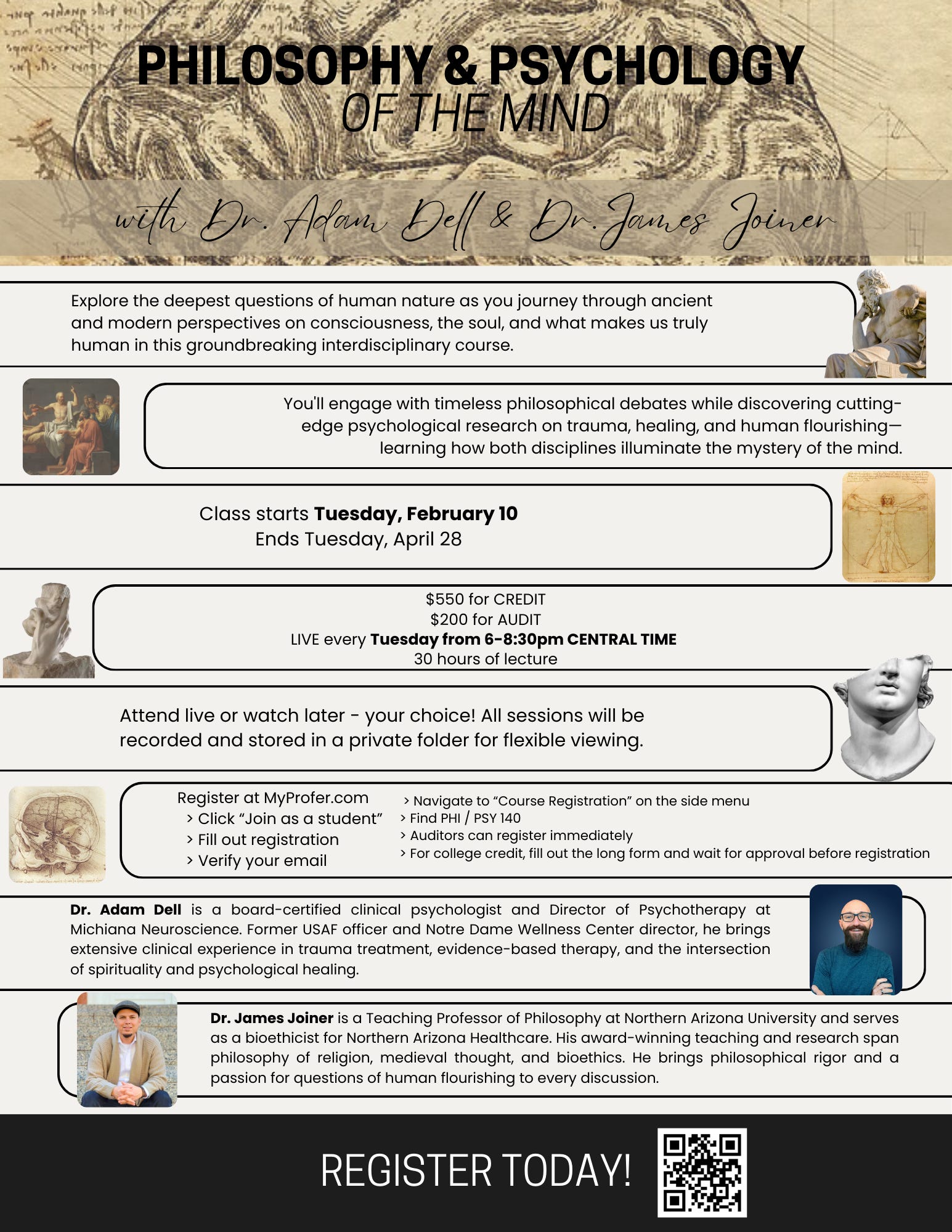
Greetings subscribers! I want to take this opportunity to commend to you an upcoming class, team-taught by Dr. Adam Dell, a board-certified clinical psychologist with vast expertise in trauma and emotional wellbeing, and Dr. James Joiner, a brilliant philosopher and one of the most gifted teachers I have ever had the privilege to observe. This rare opportunity features interdisciplinary dialogue between psychology and philosophy at the highest level — itself a rarity — while delving into profound questions about the human person, such as questions about free will, the soul, what it means to be human, and how such questions inform our understanding of human flourishing and equip us to face and overcome life’s struggles. Whether taking the course for credit (the class is accredited) or for audit, this class is an unparalleled chance to learn at the feet of these two exceptional scholars. I cannot recommend it highly enough to anyone and everyone. Scroll to the bottom for enrollment details.
Now I’ll hand the keyboard over to Dr. Joiner. Enjoy!
Dr. James Joiner is a Teaching Professor of Philosophy at Northern Arizona University and serves as a bioethicist for Northern Arizona Healthcare. His award-winning teaching and research span philosophy of religion, medieval thought, and bioethics. He brings philosophical rigor and a passion for questions of human flourishing to every discussion.

The fourth-century philosopher and theologian Augustine of Hippo once observed that people traveled to wonder at the height of mountains, at the huge waves of the sea, at the long courses of rivers, at the vast compass of the ocean, at the circular motion of the stars—and yet they passed by themselves without ever wondering.
This new course on the philosophy and psychology of mind takes that challenge seriously. This spring, Dr. Adam Dell and I will co-teach a course that investigates two foundational questions: What is a human being? And how do human beings flourish?
I’m currently a professor of philosophy at Northern Arizona University, where I specialize in the philosophy of religion and bioethics. I also work as a bioethicist for a regional medical center, where I direct clinical ethics consultation, ethics training, and policy analysis.
Years of teaching at the university have introduced me to countless students who started out in psychology seeking two things: to understand themselves and others, and secondly, to discover how to help people. Unfortunately, they came away extraordinarily dismayed because they did not gain insight into either of those areas. This course aims to rectify that deficiency.
Part One: Theories of Human Nature
The first half examines the major theories of human nature. Questions include: What constitutes a human being? Are human beings biological machines or advanced apes? Are we spirits chained to the material world? Are we bundles of energy transferred from organism to organism? Are we embodied souls, or something else?
What is consciousness? And what, if anything, distinguishes us from everything else—from other animals to, say, artificial intelligence?
Do human persons possess free will? Genuine volitional capacities? Or are we simply the determined outcome of forces beyond our control?
A striking pair of real events illustrates the stakes and the conundrums surrounding these questions. A couple of years ago, I read about two unrelated incidents that happened in the very same location on the very same day. It was at a hotel, and a young woman—mother of two, I believe—checked herself into the hotel and went up to her room and tragically ended her own life.
But she did leave behind a note, and it said, quote: “Don’t cry for me because I’m not even human.”
As the story came out, she had been involved in an illicit affair that had just been exposed, and presumably she was looking at the fallout of her decisions and how it would destroy her own family. Yet in the face of that, she ended her own life with the question on the front of her mind that she saw herself as somehow subhuman, having subjected herself to her baser instincts.
Now, at that very same hotel, on the very same day, there was a seminar going on. And in that seminar, there were about 100 people who had come to listen to a guru giving self-help advice, chanting together in unison a refrain that they said over and over again. They repeated the phrase: “I am God. I am God.”
What caught my attention about these two separate, unrelated instances is that they both centered around a kind of confusion about what it means to be a human being. Of course, in the tragic case of this young wife, she saw herself as somehow subhuman. And yet with the seminar, they were attempting to see themselves in some way as superhuman. Both of these represent distortions in how we understand ourselves.
Part Two: Human Flourishing
In the second half of this course, we will be led by Dr. Adam Dell, and it will address issues of trauma, healing, resilience, well-being, and the conditions that support and promote human flourishing. What causes deep trauma, and what pathways lead out from it? What is genuine happiness, and how can it be cultivated?
Dr. Adam Dell is a board-certified clinical psychologist and director of psychotherapy at Michiana Neuroscience, previously serving as an officer and therapist in the United States Air Force and as director of emotional well-being at the Notre Dame Wellness Center.
Together, we will integrate philosophy and psychology to explore one of the most consequential questions anyone can ask: What does it mean to be human? And how do we truly live well?