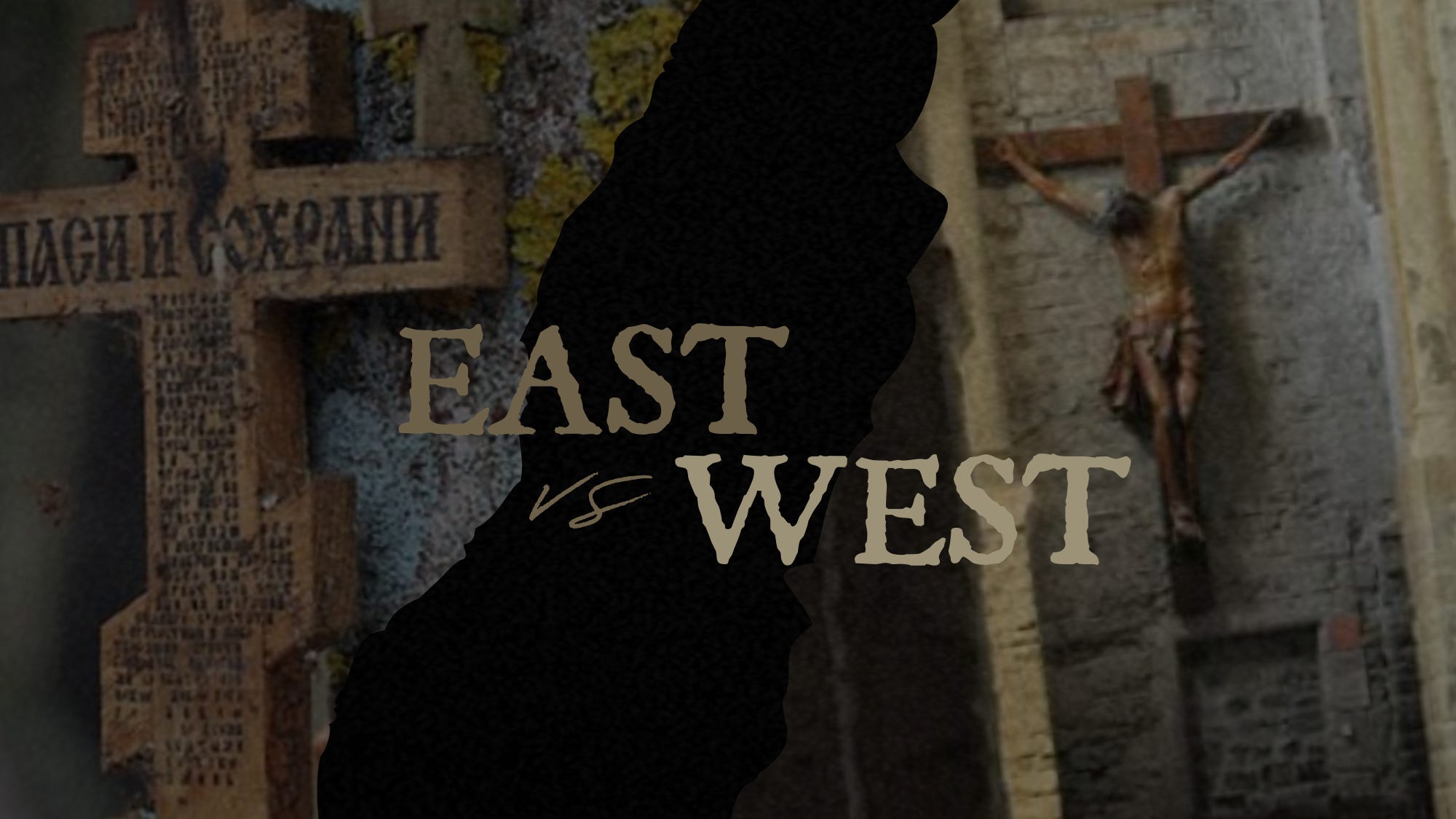
This is a portion of first lecture from The East-West Series, a 25-lecture exploration of the fundamental differences between Eastern and Western Christianity. I’m currently crowdfunding to complete production of the full series, which will launch Summer 2026.
If this work resonates with you, I hope you’ll consider backing the project. Supporter tiers start at the lowest price the series will ever be offered, and go up to tiers that include live Q&A sessions, a 14-week live course, and private calls with me.
Watch the series trailer:
The modern religious landscape has recently been host to a rather surprising trend: Westerners, both young and old, have grown increasingly interested in Eastern Orthodox Christianity. Following a notable exodus from religion nearly a decade ago, many are now returning to religion, and Eastern Orthodoxy — an ancient but notably small tradition within the United States — is one of the havens to which religious pilgrims have turned. But despite the allure of the Christian East, many find the differences between Eastern and Western Christianity to be unclear. The uninitiated sense that a great many differences exist, brushing against examples both in print and online, but inquirers often struggle to pinpoint the exact nature of these differences and what it all means.
One might expect that the most natural starting point is to ask a native member of the Orthodox Church. However, those who have known only Eastern Christianity often struggle to explain its doctrines to the Western mind. Why? Simply put, Eastern and Western Christianity share a common vocabulary, born from common Scriptures, and even a common Creed (the Nicene Creed). Yet, how these traditions understand this common vocabulary is worlds apart. Therefore, the Eastern Christian often fails to understand the questions being asked by a Western Christian, and the Western Christian is no better equipped to understand the answers offered by the East. For these Western questions are informed by a very specific history, with very specific concerns, that inform very specific understandings of the Christian faith and its vocabulary.
In short, the two parties often talk past one another. What is needed is a translator, one who not only understands Eastern Orthodoxy but also the Western mind — its history, the presuppositions and concerns born from this history, and the resulting vocabulary. Only by understanding such things, can one translate the Eastern doctrines into terms that make sense to the Western mind. Such translation work is the goal of the present series.
Those familiar with my scholarship and my podcast know that my studies took me down a long, winding road through the history of ideas. Over the course of nearly two decades, I devoted myself to the Western Christian tradition, studying the early Latin fathers, Augustine of Hippo, and both medieval and post-Reformation scholasticism. The result was a firm grasp on the historical development of both Roman Catholic and Protestant theology. In addition, these studies of Western thought carried me beyond the Reformation into the waters of Modern philosophy, where I devoted myself to figures whose ideas have shaped our contemporary culture, including modern Christianity in the West. Yet, as those familiar with my story also know, my studies ultimately led me, not to the halls of Latin Christianity, but to the Eastern Orthodox Church. The very translation work described above is the task to which I have devoted the last eighteen years.
In this series, I hope to offer a guide for the perplexed, serving as the very type of translator described above, one who can help demystify the differences between the Christian East and the Christian West. So, over the course of the next twenty four lectures, I will be your guide as we tour the roads that divide the East from the West.
Before surveying the content of this series, I think it worth commenting on several trends that occasion the creation of this series. The first has already been noted, namely, the growing interest in Orthodox Christianity throughout the Western world. But to this I would add two additional observations about Orthodox inquirers.
The first addition is that Orthodox inquirers often feel torn between Roman Catholicism, on the one hand, and Eastern Orthodoxy, on the other. Such inquirers have already written off Protestant Christianity, and thus find themselves on a quest for the original or true Church — a quest that leads them to his fork in the road. Without any judgment or criticism of those who have felt this inner tension, I admit that I find it peculiar. For, as we will see in this series, Orthodoxy and Catholicism are worlds apart, theologically speaking. I can understand the tension if one’s primary worry is to discern which one is the keeper of the Apostolic faith — very well. But I can’t help but wonder if the tension is indicative of something else.
Often, newcomers to Orthodox Christianity will presume that it has more in common with Catholicism than with Protestantism, since the two have a certain superficial resemblance — vestments, candles, liturgy. But the reality is that Catholicism and Protestantism have far more in common with one another than either has in common with Orthodoxy. The reason is obvious enough from a strictly historical perspective. Protestant Christianity arose as a protest against Roman corruption, and this protest was championed by Roman Catholic theologians. The presumptions of the Reformers are inherently Catholic. The disputes are thus “in house,” as it were — Latin Christians disputing nuances of Latin Christianity.
Hence, when a Latin Christian turns to the Orthodox and asks where he stands on such disputes, the Orthodox Christian can hardly answer. For the dispute is born out of a theology wholly alien to Eastern Christianity. In truth, the Orthodox Christian has no stance on the dispute because he shares none of its premises. His theology is wholly other. For this reason, it’s a fool’s errand to look at Western taxonomies about sin or salvation or baptism or predestination and ask which one is the position of the Orthodox. For these taxonomies are the outgrowth of a uniquely Western discussion, reflective of uniquely Latin presumptions and a uniquely Latin understanding of the Christian faith — an understanding the Orthodox do not share. So, Orthodoxy can no more be placed into one of these Western boxes than a round peg in a square hole. To truly understand the differences between East and West, then, we must dig down to the very foundations, since the root differences are anything but superficial.
A second observation I would add is this. Those drawn to the Orthodox Church come from all backgrounds and for a host of reasons — some due to theology, others history, others liturgy, others art, and others from a search for meaning. Rarely does an inquiry not find something that raises questions, concerns, or confusion. For those from Protestant backgrounds, especially, the list is often predictable — Mary, icons, prayer to Saints. But despite whatever questions might hang in the air, many inquirers find themselves drawn to the Church, despite such questions — as if their heart longs to enter, but their head holds them back. The result can sometimes be a form of unintentional syncretism. What I mean is this.
Often, inquirers are so eager to enter the doors of the Orthodox Church, they focus their questions strictly on those areas that strike them as peculiar or obviously different from their present way of thinking. The tacit presumption is that the other areas of their theology or worldview must be aligned with Orthodox Christianity. But given the vast differences between East and West, this is rarely true. Hence, many converts retain a great deal of Western theology, under the presumption it is perfectly Orthodox, only trading out a few fixtures here and there for an Eastern alternative. The result is a peculiar hybrid of Eastern and Western Christianity — something unintentionally syncretistic, which is neither here nor there.
What is needed is for the convert to continue to turn over the soil of his worldview, cultivating a fully Orthodox mind. But as noted, the syncretism here described is unintentional. Most converts have no idea they retain Western ideas that are alien to their newfound Orthodox faith. Hence, to turn over the soil thoroughly, they require a guide to help reveal the remnants of their Latin Christianity and to see how these remnants are incompatible with their commitment to Eastern Orthodox Christianity.
Such is the purpose of this series: To offer a guide to those curious about the differences between the Christian East and the Christian West, to offer a deeper sense of the differences between Catholicism and Orthodoxy, and to help the Eastern convert continue his efforts to more fully appropriate an Orthodox mind.
When considering the numerous differences between the Christian East and the Christian West, I think it fair to identify these core differences as traceable to four main areas: The doctrine of God, the understanding of God-world interaction (or what is called “providence”), anthropology or the nature of man, and salvation or the Christian gospel.
The idea that the Christian East and the Christian West differ on the doctrine of God may come as a surprise, since they share a common Creed — the Nicene Creed. But as we will see, these two traditions harbor significant and often irreconcilable differences on the matter. Within the Latin West, a particular brand of “divine simplicity” is first planted by Augustine of Hippo and then grows into full bloom in Anselm of Canterbury and the medieval scholastics after him. This doctrine affects how Augustine and Latin writers after him use the word “God” (deus), how they understand the Trinity, how they interpret the divine attributes, and a host of other things. Truthfully, the cascading effect can hardly be overstated. And yet, as we will see, the doctrine of simplicity that proves fateful for the Latin West — along with its reverberations throughout the doctrine of God — is wholly alien to the Eastern Church fathers. As a result, a great chasm emerges between how the East and the West understand divine simplicity, the divine attributes, and even the Trinity itself. So, despite a common Creed and an overlapping vocabulary that gives the impression of common doctrines, the resulting teachings about God are vastly different.
These differences in the doctrine of God naturally unfurrow into differences about God-world interaction — or what is called “providence.” The understanding of God that follows from the Latin view of simplicity naturally raises a host of questions about divine knowledge, divine freedom, and divine causality: How is it that a God of this sort can create, know, and care for our world? Perhaps the best way to understand medieval scholasticism is as a manifold wrestling with these very questions. The various answers explored by the Latin scholastics would go on to shape not only Catholic thought, but also Protestant thought and even the philosophical thought of the Enlightenment — a shape that still lingers in the minds of most Westerners today, whether knowingly or unknowingly. Yet, once again, the Western presumptions that underwrite this discussion are wholly alien to the thought of the Eastern Church fathers. And for this reason, we find in the Christian East a very different perspective on divine knowledge and divine freedom, on how God both cares for and interacts with the world, on his immanence and relationship to creatures, and even his relationship to time itself.
The contrast between how the East and West see man is no less stark than the contrast in the doctrine of God. Within the Latin West, the Pelagian dispute marks a defining moment in how Augustine of Hippo and Latin writers after him come to see the nature of man, of sin, and of grace. From this point onward, Pelagianism becomes a redline that none might cross without charge of heresy. The result definitively shapes Western thinking about the natural world, about the nature and effects of the Fall, and the nature of the grace required to remedy these effects. And the results, in turn, shape Latin thinking about man’s relationship to God and God’s dealings with man. Once again, however, this uniquely Latin discussion is alien to Eastern Christianity. The Eastern Church fathers harbor a very different perspective on the nature of man, which, in turn, leads to a very different perspective on the natural world, on the nature of the Fall and its effects, on the nature of grace, and all of this offers a very different picture of man’s relationship to God and God’s dealings with man than what we find in the Latin West.
To no surprise, the Latin convictions about the nature of man definitively color the Western understanding of the Christian gospel. The human condition is marked primarily by moral guilt and impending future judgment, with the redemptive work of God in Christ offering to humanity absolution and grace, defined either as supernatural aid to enable man to perform deeds that have merit before God (Roman Catholic) or unmerited favor that places one in favorable standing with God despite his moral guilt (Protestant). But in either case, the human condition, the nature of divine grace, and the redlines first defined by the Pelagian dispute are common across Western Christianity, both Catholic and Protestant. Yet, much like the Latin understanding of man, the Latin view of the gospel is entirely alien to the Christian East. The root of the human condition, the remedy offered by the gospel, and the nature of divine grace are entirely different within Eastern Christianity — so much so that the disputes of the West make little sense to the Eastern mind.
Within this series, we will explore not only these four central differences, but how these roots differences concerning the nature of God, of providence, of man, and salvation play out in related doctrines of atonement, predestination, even ecclesiology and liturgy. The format for this series is simple. Each topic will be divided into two lectures, one on the Christian West, providing the framework with which most listeners are familiar, and then a second lecture that contrasts the Latin view with the lesser-known position of the Christian East. The topics we cover will unfold as follows. We will begin with anthropology, looking at two perspectives on the nature of man. We will then turn to the doctrine of God, with emphasis on the doctrine of the Trinity. From here, we will turn to providence, exploring how these two traditions understand God and world to relate to one another. With this, we will turn to a trio of topics concerning the gospel, namely, the Incarnation, the nature of atonement, and the understanding of salvation. Following this trio, we will look at the respective understandings of Mary, of predestination, of ecclesiology or the nature of the Church, of divine revelation, of iconography, and of liturgy. The result will be twenty four lectures, covering these twelve topics.
Stay tuned for part 2 of the first lecture. If you found this valuable, please consider backing the full East-West Series. Your support will help bring all 25 lectures to life.
Can’t contribute right now? Becoming a paid Substack subscriber helps support all my work, and you’ll unlock my full archive plus the 15+ hour Orthodox Foundations series.